
Search

Involving people with lived experience

Guidelines for meaningful engagement of people with lived experience of forced migration

People with lived experience of forced migration bring essential knowledge, expertise, and insight. Embedding their involvement is central to the New Scots Refugee Strategy. People with lived experience inform the strategy, take part in the governance of the strategy and are meaningfully involved in the implementation of the actions of the New Scots Delivery Plan.

Learning from and working alongside people with lived experience supports better decision-making processes and improves the planning, running, design, and development of services, policies, and public perceptions.

This guidance aims to support organisations leading on New Scots actions to fully ensure refugee engagement and involvement. It reflects the experiences of the New Scots Core Group Advisers, and draws on wider sector research. Lessons have been incorporated from other fields, including homelessness and mental health, where lived experience leadership models are more developed. This creates opportunities to develop sector-specific models, adapt involvement toolkits, and strengthen pathways for lived experience leadership.

The purpose of this guidance is to set out definitions, principles, and approaches to meaningful involvement, while recognising systemic barriers, risks, opportunities, and practical considerations. It provides a coherent framework for embedding lived experience alongside practical recommendations for ensuring involvement is meaningful, ethical, and impactful.

Definitions

In this guidance, a person with lived experience refers to ‘New Scots’ as defined in the New Scots Refugee Integration Strategy 2024 people living in Scotland who have been forcibly displaced or are making a claim that they have a well-founded fear of persecution. The term ‘New Scots’ includes people who have been granted refugee status or another form of humanitarian protection, and their dependents; people seeking asylum and people seeking protection as a result of displacement, exploitation or political persecution; as well as those whose application for asylum has been refused, but who remain in Scotland. It also includes people who are or may become stateless and in need of international protection.

New Scots partners understand that there is not universal consensus around the term New Scots but the consultation has shown that there was agreement on the fact that it conveys a helpful message of inclusion to all who need safety in Scotland for as long as they need it.
Why Lived Experience Matters

Historically, New Scots have often been treated as passive recipients of policy decisions rather than active participants, resulting in tokenism and exclusion. Recognising lived experience is therefore not only good practice but a matter of justice. People with first-hand experience of asylum, displacement and refugee systems bring unique knowledge and insight, helping to make services and policies more inclusive, responsive, and effective (Campbell & McKenzie, 2016), while also strengthening organisational legitimacy and accountability. Meaningful engagement requires a commitment to ethical and inclusive practice, fostering self-determination, respecting dignity, and recognising people with lived experience as experts in their own right (Global Refugee-led Network, 2019). At the same time, it is important to question our own assumptions about involvement, the language we use to define lived experience, and the narratives we centre, recognising that these choices shape both whose voices are heard and how engagement is experienced.

Approaches to lived experience engagement

Drawing on the Meaningful Engagement of People with Lived Experience Toolkit (National Survivor Network, 2023), this guidance recognises three approaches:

Lived Experience-Informed: Engagement with a diverse community of people with lived experience, whose input shapes policies, services, and activities from design through evaluation. This requires awareness of power imbalances and vigilance against tokenism.

Lived Experience-Centred: Places the rights, dignity, strengths, and needs of people with lived experience at the heart of all efforts. Their voices are prioritised in decision-making, with collaboration aimed at transforming the conditions that perpetuate exclusion.

Lived Experience-Led: Positions people with lived experience in leadership roles, decision-making processes, and governance structures, recognising their expertise as fundamental to fairer systems and sustainable solutions.

This guidance provides a practical framework for planning, delivering, and evaluating lived experience engagement activities.

The guidance is:

  • For practitioners to be able to embed lived experience engagement.
  • To promote consistency, ethical practice, and sustainability in all engagement activities.
  • To learn and adapt from best practices shared across sector.
  • To build pathways that progressively move towards leadership and empowerment.

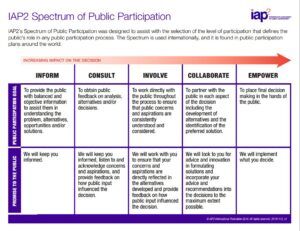
This guidance recognises that lived experience engagement exists on a spectrum, drawing on the IAP2 Spectrum of Public Participation (2023). Lived experience engagement exists on a scale, rather than as an on/off switch. Engagement can be understood as:

  • Inform: Participants receive information but do not influence decisions.
  • Consult: Feedback is actively sought and considered.
  • Involve/Collaborate: Participants share influence and co-produce outcomes.
  • Empower: Participants lead decision-making and strategic direction

The spectrum approach allows practitioners to plan activities that gradually increase influence while ensuring participation is ethical, safe, and meaningful. The nature and extent of involvement will vary across work areas, contexts, and issues. While consultation remains important, the ultimate objective is to foster open, collaborative relationships with people with lived experience, including shared decision-making and joint action where appropriate. This guidance builds on existing organisational culture, acknowledging its limitations while providing a foundation for continuous development.

Core Principles of Lived Experience Involvement

These are clear principles and practical models to guide safe, meaningful, and sustainable participation.

All involvement of people with lived experience should follow these principles:

Clarity of Purpose – Be clear on why people are involved, what is expected, and how input will shape outcomes.

Inclusion and Accessibility – Anticipate and remove barriers such as childcare, travel, digital access, and language.

Recognition and Respect – Value expertise through fair compensation, training, and opportunities for growth.

Trauma-Informed and Culturally Safe – Avoid re-traumatisation, respect cultural context, and provide emotional support where needed.

Transparency and Accountability– Share feedback on how contributions influenced decisions.

Progression and Sustainability – Create pathways for leadership and embed participation in organisational practice.

Equity, Consent, and Safeguarding – Ensure power-sharing, voluntary participation, and safe processes.

Evaluation and Learning – Regularly review and adapt engagement based on feedback and impact.

Types and Levels of Lived Experience Involvement 

Different levels of participation depend on skills, interests, and context. 

Levels of Participation 

  •  Engagement/Inform: One-off interactions such as surveys, focus groups, or interviews. Participants are informed and provide insight but do not influence decisions directly.
  • Consultation: Structured opportunities to review or comment on proposals, policies, or service design. Feedback is actively considered in organisational decisions.
  • Involvement/Influence: Regular participation in advisory groups or committees where participants shape services, policy, or strategy.
  • Co-Production/Co-Design: Equal partnership in designing, implementing, and evaluating services or policies. Decision-making responsibilities are shared.

Leadership/Empowerment: Participants hold decision-making authority, e.g., trustees, project leads, or advisory chairs. Leadership can include mentoring others,representing the organisation externally, or guiding strategic initiatives.

Practical Tip- Choosing the right model depends on purpose, resources, and participants’ aspirations. All roles should include support, feedback, and clarity on whether involvement is voluntary or paid. 

Planning and Preparation

Effective lived experience engagement begins with careful planning. Practitioners should: 

  • Conduct background work: Map existing knowledge, identify gaps, and avoid duplication with previous engagement activities.
  • Draft a purpose statement: Develop a clear, concise statement of intent (1–2 lines) and set out terms of reference for the engagement. This ensures all participants and staff understand the objectives and scope.
  • Define outcomes: Establish SMART outcomes – specific, measurable, achievable, relevant, and time-bound – to evaluate the success of engagement.
  • Set timeframes: Allow a minimum of six weeks lead-in time to build trust, secure participation, and make necessary access arrangements.
  • Integrate operationally: Ensure involvement activities are embedded in teamwork plans, budgets, and timelines, not treated as optional add-ons. 

Project Partners